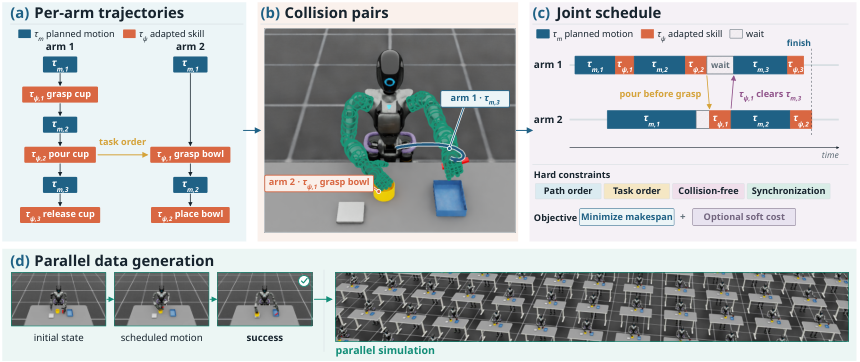
Two robot arms can often work in parallel, but one arm may need to wait for the other to finish a movement or clear a shared workspace. ScheduleGen adapts a small set of demonstrations to new scenes and schedules the motions of the arms together. It generated successful demonstrations at an average rate of 79.6% across 28 simulated task variants. Policies trained on generated data achieved 50–80% success across eight physical variants.
† Equal advising.